
No products in the cart.
Return To Shop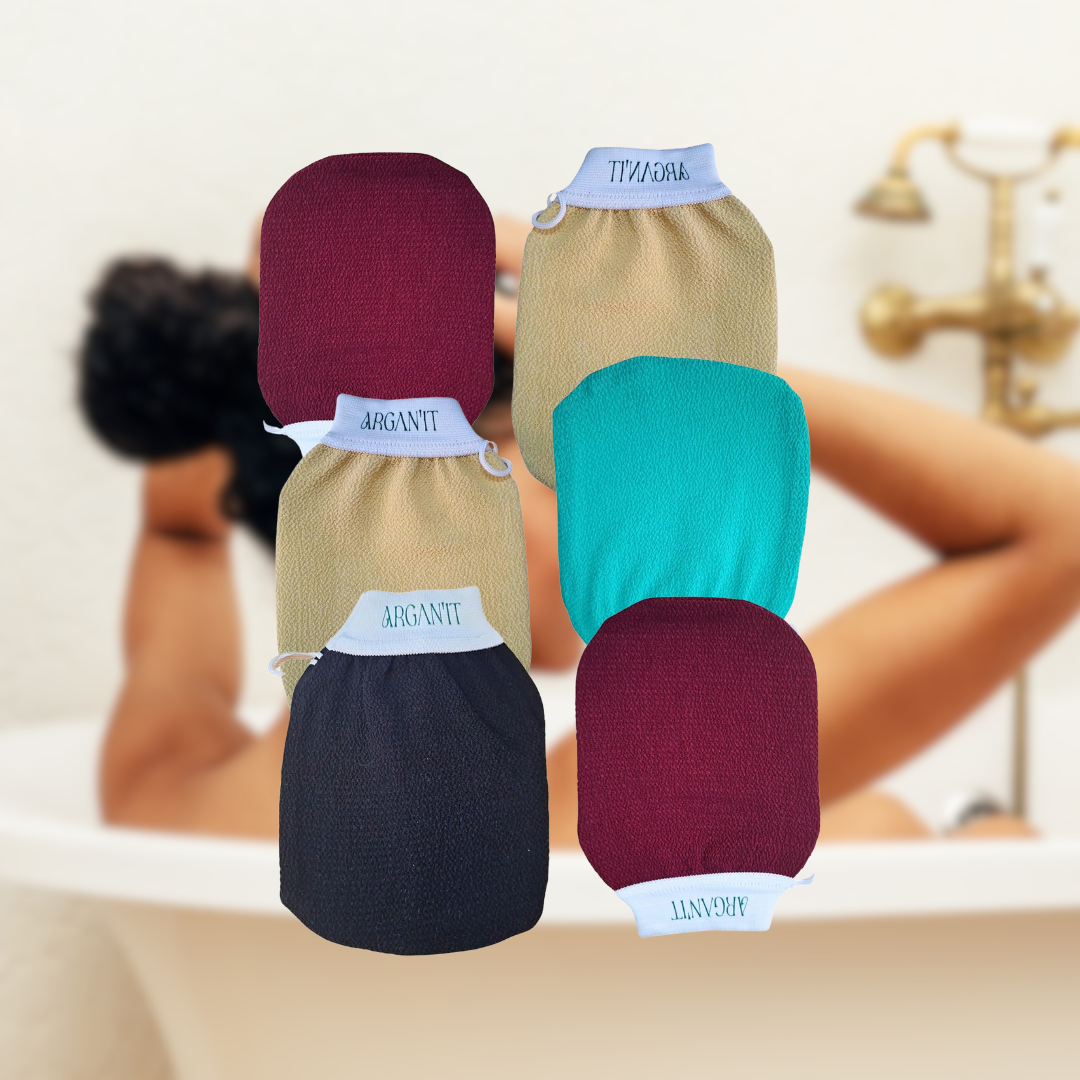
What Is a Kessa Glove Made Of? Materials and How to Choose One
A Moroccan kessa glove is a coarse, woven exfoliating mitt. Most are made from viscose (rayon), a plant-based cellulose fiber, woven tightly so the surface grips the skin; some use other synthetic or natural fibers. Used on wet skin after black soap, it rolls away dead skin. The texture, not the color, decides how strong the exfoliation feels.
Key facts
- Common material: viscose (rayon), made from wood cellulose.
- Other materials: nylon or polyester blends, and natural fibers in some versions.
- Texture grades: from fine (gentle, face and sensitive skin) to coarse (body, weekly hammam).
- Use with: Moroccan black soap, on warm, wet skin.
How the material affects the scrub
- Viscose kessa: the traditional hammam feel; firm grip, rolls dead skin effectively.
- Synthetic blends: durable and quick-drying; feel can be harsher.
- Finer weaves: gentler, for the face, neck or first-time users.
How to choose
- Choose a coarser glove for the body and a finer one for the face.
- Pick a size that fits snugly over your hand so you can apply even pressure.
- Check that the stitching is firm along the edges.
Care
- Rinse after each use and hang to dry.
- Wash in warm soapy water every week or two.
- Replace every few months, or sooner if the texture wears smooth.
For the full method, see our kessa glove vs Korean exfoliating mitt comparison.
Frequently asked questions
What is a kessa glove made of?
Usually viscose (rayon), a cellulose-based fiber woven into a coarse texture.
Is a kessa glove the same as a Korean Italy towel?
They are similar in purpose and material, but are used in different bathing traditions with different soaps.
How often should I use a kessa glove?
Once a week is typical for the body; less often on sensitive skin.
Where can I buy a kessa glove in the US?
Artossi sells Moroccan kessa gloves and hammam sets, shipped from Miami across the US.


Related posts

Moroccanoil is a hair-care brand; pure argan oil is a single natural ingredient. How a branded argan-infused treatment differs from 100% argan oil, and when... Continue reading
Pure Moroccan argan oil softens hair, tames frizz and adds shine. How to use it as a pre-wash treatment, a leave-in for ends and a... Continue reading

Rhassoul clay can replace shampoo once or twice a week: it cleans the scalp without foaming or sulfates. How to mix it, how to apply... Continue reading
Rhassoul (ghassoul) clay from Morocco is gentle and silky; bentonite is stronger and more drawing. How they differ for face masks, hair washing and sensitive... Continue reading

Moroccan black soap is an olive-oil paste used with a kessa glove; African black soap is a solid bar made from plant ash and shea... Continue reading